

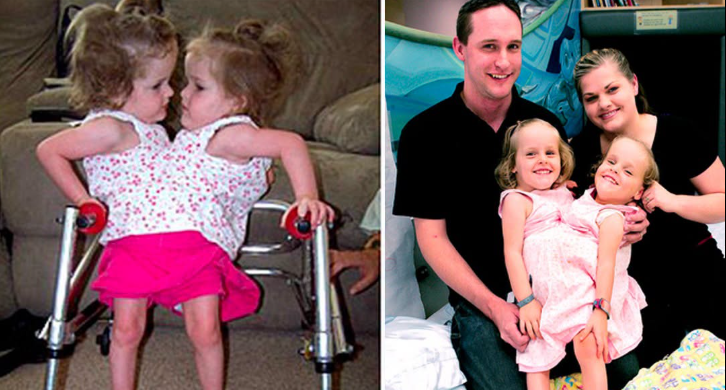
Kendra and Maliyah Herrin were four years old when they lay in separate beds for the first time. The beds were side by side in a Utah intensive care unit. One sister had the kidney they had shared since birth. The other would need dialysis until she was ready for another operation.
Their mother, Erin, was already planning to give Maliyah one of her own kidneys.
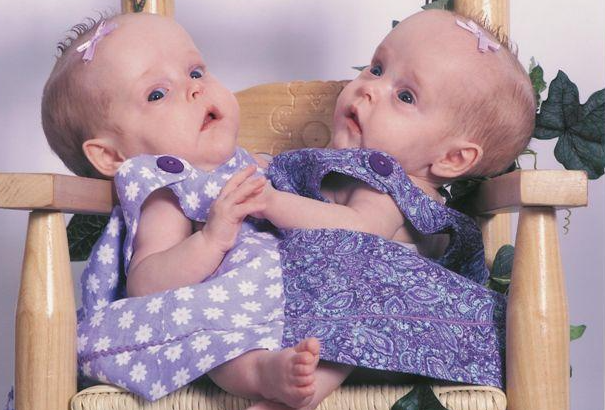
For four years, every step took two
Born in Utah in 2002, Kendra and Maliyah were joined at the abdomen and pelvis. They shared a liver, part of their intestine, a pelvis and one functioning kidney. They had two legs between them, and each sister controlled one. A step across the room took coordination from both girls.
Before surgery, the twins talked about things they wanted to do afterward. They wanted to sleep in bunk beds and ride bikes. Kendra had a particular bike in mind. She wanted a princess bike, and she wanted to go fast.
Their parents, Erin and Jake, talked with the girls about the operation. The family had years to consider what separation would mean, and the doctors had to plan for two different recoveries. The kidney was in Kendra’s body. Once the sisters were separated, Maliyah would lose access to it. Doctors waited until she was older and better able to undergo a transplant.
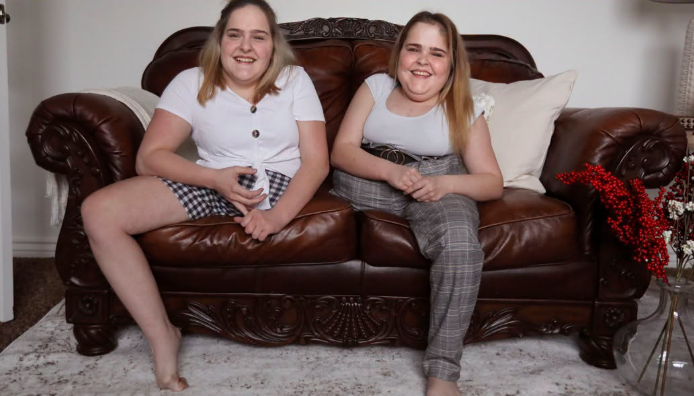
The operation lasted through the night
In August 2006, the girls were taken into surgery at Primary Children’s Medical Center in Salt Lake City. The team had to divide shared organs, reconstruct each girl’s pelvis and close the surgical wounds. Each sister would keep the leg she had always controlled.
By late that evening, the twins had been physically separated. Hours of reconstruction still lay ahead. Maliyah was moved into intensive care the following morning. When the surgeons finished with Kendra, they put her bed next to her sister’s. The operation had lasted about 26 hours.
In September, family, friends and neighbors welcomed the girls home with balloons. There were purple ones for Kendra and yellow ones for Maliyah. The twins wanted to see their new beds. Soon Kendra was playing on the computer and Maliyah went out in a stroller. Both girls played with their little brothers.
Home still meant physical therapy, hospital visits and, for Maliyah, dialysis three times a week. The next operation was already part of the family’s plans.
Eight months later, their mother went into surgery too
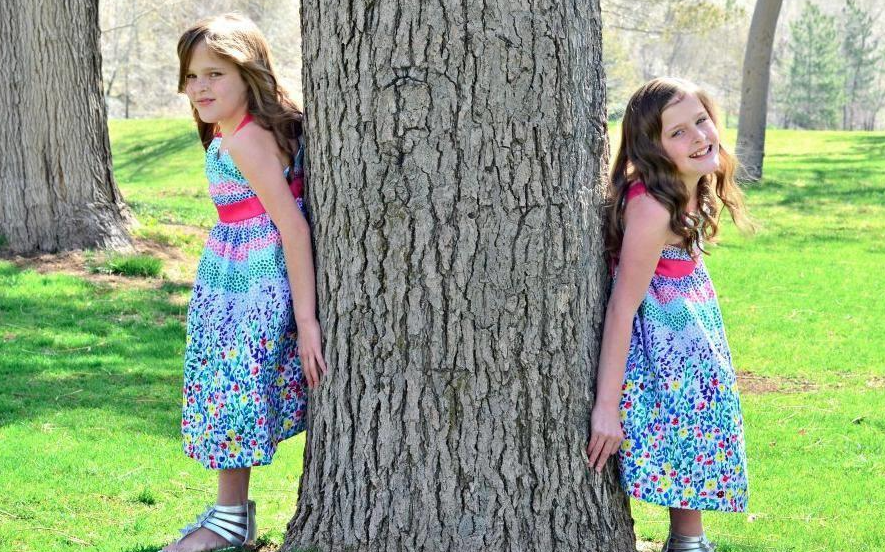
On April 3, 2007, Erin donated her right kidney to Maliyah, who had just turned five. Erin went home first. Maliyah stayed in the hospital for further recovery and to give doctors time to adjust her medication. Later that month, she went home too.
The kidney worked for several years. When it eventually failed, Maliyah returned to dialysis. In an update in April 2018, the family described two years of waiting and repeated treatments. That May, Maliyah received a second kidney transplant. The family reported that the operation had gone better than they had expected.
The sisters had their own stories to tell
As children, both girls faced additional surgeries and learned ways to move independently. In 2010, a reporter documented Kendra practicing her balance on a new prosthetic leg. The same report showed Maliyah jumping on the trampoline at home. Each sister had her own way of getting around.
By 2019, they were high school seniors. When they spoke to the Deseret News, they talked about disability, inclusion and what it felt like when strangers took pictures without permission. They still remembered a man who photographed them at Disney World. The trip had been arranged through Make-A-Wish, and years later that encounter was still part of what they remembered about it.
Before the operation, people asked Kendra what she wanted to do after she and Maliyah were separated. The adults were thinking about dialysis, reconstruction and recovery. Kendra was thinking about a princess bike. She wanted to see how fast she could go.
Kendra and Maliyah Herrin: The Life Beyond the Miracle and the Future They Never Stopped Dreaming About
When Kendra Herrin was just four years old, she dreamed of riding a princess bicycle as fast as she could. At the time, it was a simple childhood wish. But behind that innocent dream was a reality few children would ever have to face.
Kendra and her twin sister, Maliyah, had spent the first four years of their lives physically connected. Every movement required cooperation. Every step belonged to both of them. And every decision about their medical future carried risks that most families could hardly imagine.
Years later, the little girls who once shared a body had grown into young women with their own personalities, ambitions, and dreams.
But growing older brought challenges that no surgical team could completely prepare them for.
The world knew Kendra and Maliyah as the twins who survived an extraordinary separation operation. Their family knew them as two daughters who had spent years learning how to navigate a world that was not always designed for people with disabilities.
And the sisters themselves wanted something even simpler.
They wanted to be recognized for who they were, not only for what they had survived.
Growing Up Beyond the Headlines
As Kendra and Maliyah entered their teenage years, the public attention surrounding their childhood surgery became only one part of their lives.
They attended school, developed friendships, discovered different interests, and began thinking about their futures.
Like other teenagers, they faced questions about independence, education, and what adulthood might look like.
But unlike many of their classmates, they also had to navigate the physical realities of living with one leg each.
Their childhood had already involved years of rehabilitation and learning new ways to move. As they grew older, that determination became part of their everyday lives.
They adapted to challenges in their own ways, developing the confidence to participate in activities that mattered to them.
Yet there was another challenge that could be just as difficult as the physical ones.
It was the way strangers sometimes treated them.
Because their story had attracted international attention, people occasionally recognized the twins in public. Some were curious. Others were inspired by what they had heard about their childhood.
But not every encounter was comfortable.
In their 2019 interview with the Deseret News, Kendra and Maliyah described the frustration of strangers taking photographs without asking permission.
To someone holding a camera, the sisters might have seemed like an unusual sight.
To Kendra and Maliyah, those moments could feel like an invasion of privacy.
They were not exhibits or medical curiosities.
They were two young women trying to enjoy their lives.
Their experience raised an important question: What does it mean to celebrate someone’s extraordinary survival while still respecting their right to live an ordinary life?
For the twins, being treated with dignity mattered more than being admired from a distance.
Two Sisters, Two Different Dreams
One of the most meaningful developments in Kendra and Maliyah’s lives was the opportunity to pursue separate interests.
Before their separation, almost every physical activity had required them to work together.
Afterward, they could gradually discover what each of them enjoyed independently.
By their senior year of high school, their personalities and ambitions were becoming increasingly distinct.
Kendra had developed an interest in healthcare and earned certification in phlebotomy, the medical practice of drawing blood.
It was an especially interesting direction for someone who had spent so much of her childhood surrounded by doctors, nurses, and medical equipment.
Her experiences as a patient had given her an unusually personal understanding of the healthcare environment.
Maliyah, meanwhile, was exploring her own possibilities.
She did not need to follow the same career path as her sister. Their shared beginnings did not require them to have identical futures.
They could disagree, make different choices, and discover different passions while still remaining deeply connected.
For two girls who had once needed each other to take a single step, that freedom represented something remarkable.
And another milestone showed just how much their lives had changed.
In 2019, Kendra earned her driver’s license.
For many teenagers, learning to drive is an exciting step toward adulthood.
For Kendra, it also represented the ability to travel more independently and make decisions about where she wanted to go.
The little girl who had once dreamed about speeding along on a princess bicycle was now old enough to drive a car.
It was a striking reminder of how far her journey had taken her.
The Challenges That Did Not Disappear
Although the sisters’ separation surgery was successful, their medical history remained an important part of their lives.
Living with complex congenital conditions can involve ongoing medical care, rehabilitation, and adjustments as a person grows older.
For Kendra and Maliyah, independence did not mean that every physical challenge disappeared.
It meant learning how to build fulfilling lives while managing those challenges.
Their family had spent years supporting them through difficult decisions and uncertain recoveries.
Their mother, Erin, had experienced those challenges from an especially personal perspective.
She had watched her daughters undergo a lengthy separation operation, helped them through their recovery, and donated one of her own kidneys to Maliyah.
The family’s experiences demonstrated that major medical milestones often mark the beginning of a new chapter rather than the end of treatment.
Yet the sisters’ lives were never defined entirely by hospital visits.
They also experienced the ordinary milestones that make growing up meaningful.
Friendships. School achievements. Personal goals. Family memories.
And the increasing freedom to decide what kind of people they wanted to become.
The Meaning of Independence
For years, Kendra and Maliyah had been described through the extraordinary circumstances of their birth.
They were conjoined twins.
They shared vital organs.
They underwent a complex separation.
They survived.
All of those facts were important.
But none of them told the complete story.
By the time the sisters reached adulthood, the meaning of their journey had expanded beyond the operating room.
Their experiences had become a reminder that independence does not always look the same for everyone.
For one person, independence might mean walking without assistance.
For another, it might mean using a wheelchair confidently, driving an adapted vehicle, choosing a career, or deciding how to spend an ordinary afternoon.
What matters is the freedom to make meaningful choices.
Kendra and Maliyah had spent much of their childhood learning how to do things differently from other children.
Their lives showed that doing something differently did not make the achievement less valuable.
And their relationship offered another important lesson.
Being close to someone does not mean losing your individuality.
The sisters had once shared almost every physical movement. After separation, they could pursue separate paths without losing the shared history that connected them.
They could be different people while still being sisters.
A Childhood Dream That Became Something Bigger
Looking back at the earliest reports about Kendra and Maliyah, one detail remains especially touching.
Before their separation surgery, Kendra wanted a princess bicycle.
It was not an elaborate dream.
She was not thinking about becoming famous or inspiring people around the world.
She wanted to ride a bike and go fast.
At four years old, she could not have understood every medical complication that lay ahead.
She could not have known how many hospital visits, therapy sessions, and personal milestones would shape her future.
She simply imagined the freedom to move in a way she had never experienced before.
That small childhood wish now carries a deeper meaning.
It reminds us that behind every complicated medical story is a human being with ordinary hopes.
For Kendra and Maliyah, those hopes grew and changed over time.
The princess bicycle became part of a much larger journey toward independence, education, friendships, and adulthood.
And while the public often remembers the sisters for the extraordinary surgery that separated them, their lives deserve to be understood beyond that single event.
They are not simply two people who survived a medical miracle.
They are individuals whose lives continued long after the headlines faded.
Their story also reminds us that people with disabilities should not have to accomplish something extraordinary to deserve respect, privacy, or opportunities.
Their everyday lives matter just as much as the dramatic moments that first brought them public attention.
The Story Is Bigger Than the Surgery
When Kendra and Maliyah were born in 2002, their parents faced an uncertain future.
When the twins underwent separation surgery in 2006, the medical team worked for approximately 26 hours to give them the possibility of separate lives.
When the sisters returned home, they began the long process of adapting to their new physical circumstances.
And as they grew older, they gradually developed their own identities and ambitions.
Each stage brought new challenges.
Each stage also brought new possibilities.
The most important part of their journey was never simply that surgeons had managed to separate two bodies.
It was that two children had been given the opportunity to discover who they could become.
For the Herrin family, the future was never guaranteed.
There were difficult medical decisions, uncertain outcomes, and years of recovery.
But there were also birthdays, school days, family celebrations, and ordinary moments that might once have seemed impossibly far away.
Those moments were part of the life their parents had hoped the girls would experience.
And they were part of the future Kendra and Maliyah had worked so hard to build.
The sisters’ publicly documented journey through their teenage years does not tell us everything about their lives today. Their more recent experiences and personal circumstances should not be assumed without reliable updates.
But the story already documented is extraordinary enough.
Two little girls entered the world sharing a body.
They survived a separation that required remarkable medical planning.
They learned new ways to move.
They faced additional medical challenges.
They grew into young women who wanted to make their own decisions and be treated as individuals.
And through it all, their relationship remained an important part of their story.
The world first knew Kendra and Maliyah Herrin because they were born connected. But their most meaningful legacy may be the reminder that every person deserves the freedom to live a life that is truly their own.
The little girl who once dreamed of a princess bicycle was never simply dreaming about going fast. She was dreaming about the freedom to choose where she wanted to go.
And that is what makes the sisters’ journey so unforgettable: not only the remarkable circumstances of their birth, but the ordinary, beautiful possibilities that followed.
Kendra and Maliyah Herrin: The Sisters Who Once Shared a Body Are Now Building Their Own Futures
For most of their childhood, Kendra and Maliyah Herrin were known for something they had never chosen: being born physically connected. But as they entered adulthood, the two sisters began writing a very different chapter of their lives. One was exploring a future in healthcare. The other was discovering a passion for digital design. And for the first time, the world had a chance to see them not simply as the twins who survived a historic operation, but as two young women with separate dreams.
The changes did not happen overnight. There had been years of rehabilitation, medical appointments, and difficult adjustments. Yet by the time the sisters turned twenty in February 2022, the questions that had once surrounded their survival were being replaced by questions about their futures.
For their parents, Erin and Jake Herrin, reaching this stage of life represented something that had once seemed terribly uncertain.
Their daughters were no longer the four-year-old girls lying in neighboring hospital beds after a 26-hour operation.
They were young adults making plans.
And one of the most meaningful developments was still to come.
A New Chapter Beyond High School
Leaving high school is an important transition for most young people. It brings excitement, uncertainty, and the responsibility of deciding what to do next.
For Kendra and Maliyah, those decisions also involved considering their physical needs and finding opportunities that suited their interests.
Kendra had already earned certification in phlebotomy, giving her a qualification in a healthcare profession. Later reporting also described her working as a grocery store cashier.
These were important steps toward adult independence.
They showed that the little girl who had once depended on her sister to coordinate every movement was now developing skills and exploring employment opportunities of her own.
Maliyah’s interests began moving in another direction.
Rather than following her sister into healthcare, she pursued education in digital media.
Her choice reflected an important part of the twins’ journey: being born together did not mean they had to build identical lives.
They had spent their earliest years sharing almost every physical experience.
Now they were free to discover what made each of them different.
Maliyah’s Next Achievement
In 2022, reports described another milestone in Maliyah’s life.
She had completed a digital media program at Davis Technical College, opening the possibility of pursuing work in graphic design.
It was an achievement that had little to do with the medical procedure that first made her internationally known.
And that was precisely why it mattered.
For years, so much of Maliyah’s public story had centered on the kidney she needed, the operations she underwent, and the uncertainty surrounding her health.
Now there was another accomplishment to celebrate.
She had completed a course of study and was looking toward a creative career.
A young woman whose childhood had been filled with medical challenges was developing skills that could help shape her professional future.
The milestone also highlighted something that is easily overlooked in stories about extraordinary medical survival.
Living a fulfilling life is not only about overcoming physical difficulties.
It is about having opportunities to learn, work, create, and pursue personal ambitions.
For Maliyah, completing her studies represented another step in that direction.
Cafebiz.vn+1
Their Story Reached a New Audience
Long before reaching adulthood, Kendra and Maliyah had also found another way to express themselves.
They began creating videos and sharing parts of their lives on YouTube.
Unlike the television reports and documentaries that had followed their childhood, these videos gave the sisters more control over what they wanted people to see.
They could talk about their experiences, show their personalities, and share moments that were funny rather than dramatic.
In a 2019 report by KSL, the twins explained that they enjoyed creating entertaining videos and wanted to bring positivity to others.
Their father, Jake, believed the experience helped build their confidence.
It was a meaningful change from the attention they had received as children.
For much of their lives, other people had pointed cameras at them.
Now they could choose when to turn a camera on themselves.
They were not simply subjects of someone else’s story.
They could become storytellers.
And their videos offered viewers a chance to understand something that medical headlines rarely captured: Kendra and Maliyah had a sense of humor, everyday interests, and personalities that extended far beyond their disabilities.
KSL News+1
The Side of Their Lives People Rarely Saw
In interviews, the twins often spoke about their physical differences with remarkable ease.
They had developed practical ways to move around their home, school, and community.
But their daily routines also included activities that had nothing to do with medical treatment.
They spent time with friends, participated in family life, and shared responsibilities at home.
In 2019, the sisters described taking turns preparing dinner.
It was a small detail, but it revealed a great deal about their everyday lives.
They were not constantly living through dramatic moments.
Sometimes, they were simply deciding whose turn it was to cook.
Their relationship also included the familiar differences that exist between many siblings.
They had distinct personalities and opinions.
They could disagree about ordinary things.
And despite their unusual childhood, they did not want every conversation to revolve around the fact that they had once been conjoined.
Their lives had become much bigger than the medical history that connected them.
The Family Behind Their Journey
Throughout the twins’ childhood, their parents had played an essential role in helping them navigate extraordinary circumstances.
Erin and Jake had faced decisions that carried enormous consequences for both daughters.
Their family had experienced lengthy hospital stays, complicated treatments, and the uncertainty of waiting for medical outcomes.
But one particularly remarkable detail emerged in later reporting.
When Maliyah needed another kidney transplant, her father was not a compatible donor for her.
Instead, Jake donated a kidney through a paired-donation chain, in which donors help other patients receive compatible organs.
His donation did not go directly to Maliyah, but it contributed to a system that helps people who need transplants.
The family’s experience with organ donation had become deeply personal.
Erin had donated a kidney to Maliyah in 2007.
Jake later became a kidney donor as well.
And Maliyah’s second transplant in 2018 had given her another opportunity to live without the exhausting dialysis schedule she had endured.
For the Herrins, organ donation was not an abstract medical issue.
It had shaped their family’s life.
Deseret News+1
The Future Was No Longer Just About Survival
By their twentieth birthday, Kendra and Maliyah had reached a point that once seemed far beyond the immediate concerns of their childhood.
Their earliest years had been dominated by questions of survival and medical possibility.
Now they were exploring education, employment, creativity, and independence.
There were still challenges.
Their medical histories did not disappear simply because they had grown older.
And neither sister could know exactly what the future would bring.
But their achievements showed that the operation in 2006 had been only one chapter of a much longer journey.
The girls who once needed to coordinate every movement were now making individual decisions about their lives.
Kendra could pursue her interests.
Maliyah could pursue hers.
They could support each other without needing to follow the same path.
And the world could begin to understand them as two people rather than one extraordinary medical case.
The Dream That Never Really Changed
There is a reason Kendra’s childhood wish for a princess bicycle remains such a powerful detail in the sisters’ story.
When she was four, she did not describe her future in terms of medical achievements or public recognition.
She wanted to move freely.
She wanted to go fast.
And she wanted to experience the excitement of doing something on her own.
As an adult, that childhood dream had taken on new forms.
Independence could mean driving, working, learning new skills, or deciding how to spend her time.
For Maliyah, it could mean completing her education, developing creative abilities, and pursuing a career that interested her.
Their childhood dreams had grown with them.
The world had once watched to see whether the twins could survive separation.
Years later, the more meaningful question was what they would choose to do with the opportunities that followed.
Their publicly reported achievements through 2022 offered a glimpse of the answer.
They were building lives that reflected their own interests, abilities, and hopes.
And perhaps that is the most important lesson in their remarkable journey.
Kendra and Maliyah Herrin did not survive a historic operation simply to spend the rest of their lives being remembered for it. They grew up with the same right as anyone else to dream, learn, make mistakes, and decide what came next.
Once, they shared every step. Now, they could choose their own directions. And although their paths might lead to different places, the extraordinary bond between the sisters would always remain part of their story.